Your family is growing, you need a home office, or you simply want more space. Whatever the reason, you’re considering adding square footage to your Phoenix home. The first question on your mind is probably the cost. Understanding home addition cost Phoenix contractors charge helps you plan your budget and make informed decisions about your project scope.
This guide breaks down everything you need to know about home addition pricing in the Phoenix area. You’ll learn average costs per square foot, what different types of additions run, factors that affect your final price, and how to get the most value from your investment.
Average Home Addition Cost in Phoenix
Most Phoenix homeowners pay between $150 and $350 per square foot for a professionally built home addition. This puts a 400-square-foot addition in the range of $60,000 to $140,000, depending on complexity and finishes.
The wide price range reflects the huge variety in addition types. A simple bump-out costs far less per square foot than a two-story master suite with a luxury bathroom. Location within Maricopa County, current material costs, and permit fees all play a role in your final number.
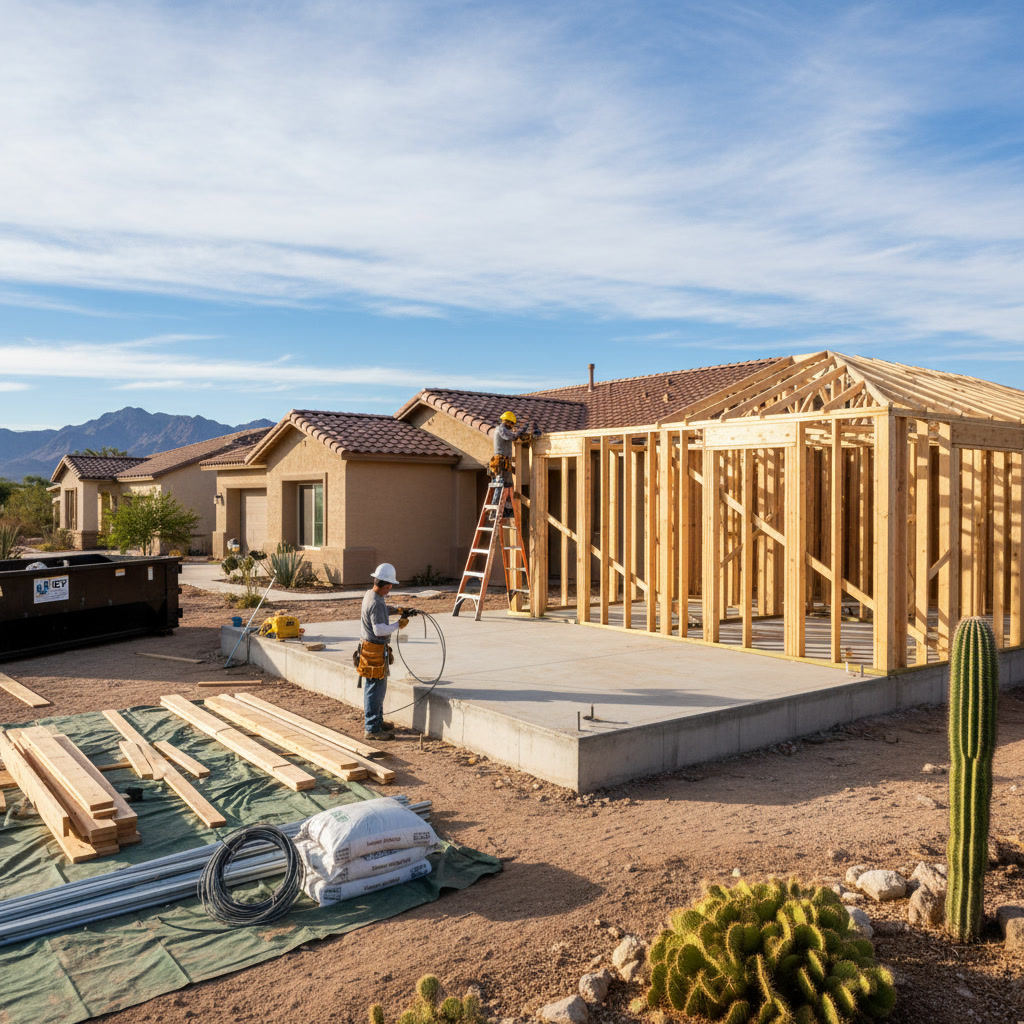
These figures include labor, materials, permits, and basic finishes. They assume professional construction that meets all building codes and includes proper foundation work, framing, electrical, plumbing, HVAC, insulation, drywall, and flooring.
Pro Tip: Phoenix’s intense heat means your addition needs proper insulation and cooling capacity. Budget for upgraded HVAC work, which can add $3,000 to $8,000 to your project but pays dividends in comfort and energy bills.
Cost by Addition Type
Different additions carry different price tags. Here’s what you can expect for common projects in the Phoenix area.
Bedroom Addition
A standard bedroom addition runs $50,000 to $80,000 for a 200 to 250 square foot room. This includes basic electrical work, one window, a closet, flooring, and paint. If you’re adding a bathroom en suite, add another $20,000 to $35,000.
Master bedroom suites with walk-in closets and luxury bathrooms typically cost $100,000 to $180,000 depending on size and finishes.
Bathroom Addition
Adding a full bathroom costs $40,000 to $65,000 for a 50 to 80 square foot space. This includes all plumbing, fixtures, tile work, ventilation, and finishes. Half baths run $25,000 to $40,000.
Luxury bathrooms with high-end tile, custom vanities, and premium fixtures can push costs to $80,000 or more.
Kitchen Addition or Expansion
Expanding your kitchen or adding a second kitchen runs $80,000 to $150,000 for 200 to 300 square feet. Kitchens are among the most expensive additions because they require extensive plumbing, electrical, ventilation, and cabinetry work.
Outdoor kitchens and covered patio additions are popular in Phoenix and typically cost $30,000 to $70,000 depending on appliances and covered area.
Sunroom or Arizona Room
These popular Phoenix additions provide extra living space while connecting you to the outdoors. Basic three-season sunrooms start around $25,000 to $40,000 for 150 to 200 square feet.
Four-season rooms with full insulation and climate control run $50,000 to $90,000 for similar square footage. Arizona rooms with large sliding glass walls and tile flooring fall in the $40,000 to $75,000 range.
Two-Story Addition
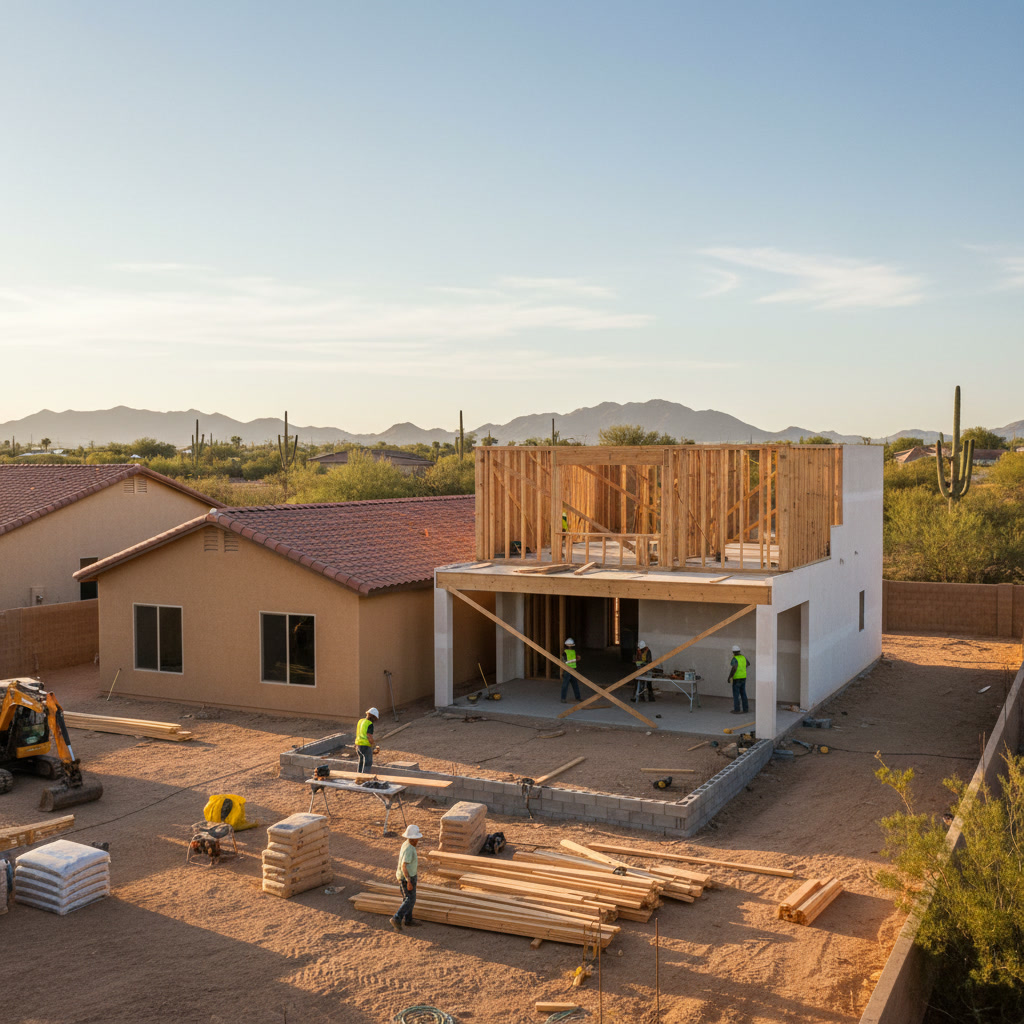
Building up instead of out costs $175 to $400 per square foot. A 600-square-foot second story runs $105,000 to $240,000. Two-story additions require structural reinforcement of your existing foundation and framing, which adds significant cost.
The advantage is preserving yard space, which many Phoenix homeowners value highly for outdoor living areas.
Bump-Out Addition
Small bump-outs of 50 to 100 square feet cost $15,000 to $35,000. These micro-additions can expand a kitchen, create a breakfast nook, or enlarge a bathroom without the complexity of a full addition.
Bump-outs often use the existing foundation and roof structure, keeping costs lower than full additions.
Factors That Affect Home Addition Cost Phoenix Homeowners Pay
Several variables influence your final price tag beyond simple square footage and room type.
Foundation Requirements
Phoenix’s caliche soil and extreme temperature swings require solid foundation work. Most additions need a concrete slab foundation, which runs $4,000 to $12,000 depending on size and site preparation needs.
Rocky soil or poor drainage can increase excavation costs. Some properties require soil testing before permits are issued.
Roof Integration
Matching your existing roofline and materials affects cost. Simple shed roofs cost less than complex hip or gable configurations. If your addition requires modifying the existing roof structure, expect to pay $8,000 to $15,000 more.
Tile roofs, common in Phoenix, cost more to match than asphalt shingles. Factor in $12 to $25 per square foot for tile versus $5 to $12 for shingles.
Permits and Inspections
Building permits in Phoenix and surrounding Maricopa County cities run $1,500 to $4,000 for typical home additions. Complex projects requiring engineering stamps cost more.
Your contractor handles permit applications, but the costs pass through to your project budget. Plan for multiple inspections during construction, including foundation, framing, electrical, plumbing, and final.
Utility Extensions
Running electrical, plumbing, and HVAC to your addition adds $8,000 to $20,000 depending on distance from existing systems. Upgrading your electrical panel costs $1,500 to $3,000 if current capacity can’t handle the additional load.
HVAC extensions or new units for larger additions run $5,000 to $12,000. In Phoenix’s climate, proper cooling isn’t optional.
Finish Level
Builder-grade finishes keep costs on the lower end of the range. Mid-range finishes with quality flooring, countertops, and fixtures add 15 to 25 percent to base costs. Luxury finishes can double material expenses.
Most Phoenix homeowners choose tile or wood-look luxury vinyl for additions, which runs $5 to $15 per square foot installed.
Site Accessibility
Easy access for materials and equipment keeps labor costs down. Properties with narrow side yards, steep slopes, or limited street access increase costs by 10 to 20 percent due to extra labor time and smaller equipment requirements.
Hidden Costs to Budget For
Smart homeowners add 10 to 20 percent to their base budget for unexpected expenses. Here are common surprise costs.
Matching discontinued materials often requires upgrading your entire addition to newer products. Exterior stucco matching can be tricky if your original finish has aged or been discontinued.
Structural issues discovered during construction add costs. Opening walls sometimes reveals outdated wiring, plumbing issues, or termite damage that needs addressing.
Design changes during construction cost more than changes made during planning. Stick to your approved plans to avoid change order fees of 15 to 30 percent above the original scope price.
Temporary housing costs apply if your addition makes parts of your home unlivable during construction. Most additions allow you to stay in place, but some kitchen or master suite projects require alternative arrangements for a few weeks.
Key Takeaway: Get detailed written estimates that break down labor, materials, permits, and other costs. This helps you compare contractors fairly and understand exactly what you’re paying for.
How to Reduce Your Home Addition Cost
You can control costs without sacrificing quality by making smart decisions during planning and construction.
Simple rectangular footprints cost less than complex shapes with multiple corners and angles. Every corner adds framing, drywall, and finish work.
Building out rather than up saves money in most cases. Single-story additions avoid structural reinforcement and complex stairway construction.
Schedule your project during slower construction seasons. Phoenix summers see less construction activity, and some contractors offer better rates during hot months. Just ensure your contract specifies proper heat safety measures for workers.
Choose standard window and door sizes rather than custom dimensions. Stock sizes cost 30 to 50 percent less than custom orders.
Handle non-structural work yourself if you have skills and time. Painting, basic landscaping, and finish trim work can be DIY projects that save $3,000 to $8,000.
Select materials wisely by balancing cost and durability. Mid-grade products often perform nearly as well as premium options at significant savings. Your contractor can recommend the best value materials for Phoenix’s climate.
Financing Your Home Addition
Most Phoenix homeowners use one of several financing methods to fund their addition.
Home equity loans provide lump sums at fixed rates, typically 6 to 9 percent as of 2024. You repay over 10 to 30 years. This works well when you know your exact project cost.
Home equity lines of credit (HELOCs) offer variable-rate borrowing up to your credit limit. You only pay interest on what you draw. Rates fluctuate with the market but started around 7 to 10 percent in 2024.
Cash-out refinancing replaces your mortgage with a larger loan, pulling equity out for your project. This makes sense when current rates are lower than your existing mortgage.
Personal loans avoid using your home as collateral but carry higher rates, typically 9 to 15 percent. Some homeowners use these for smaller additions under $50,000.
Contractor financing through your builder sometimes offers promotional rates or deferred interest. Read terms carefully, as rates after promotional periods can be high.
Return on Investment for Phoenix Home Additions
Understanding potential return helps you make smart addition choices if you plan to sell within five to ten years.
Bathroom additions typically return 55 to 65 percent of cost at resale in the Phoenix market. Adding a bathroom when your home has fewer bathrooms than bedrooms provides the best return.
Bedroom additions return 50 to 60 percent on average. Three-bedroom homes that expand to four bedrooms see better returns than four-bedroom homes adding a fifth.
Master suite additions return 55 to 70 percent, with higher returns in neighborhoods where most homes have master suites. This is table stakes in many Phoenix suburbs.
Sunrooms and Arizona rooms return 45 to 60 percent but add significant enjoyment value. In Phoenix’s climate, these extend your living season and are highly desirable to buyers.
The best returns come from additions that fix functional deficiencies, like adding a second bathroom to a one-bath home or creating a master suite in a home without one.
Choosing the Right Contractor
Your contractor choice affects both cost and quality. Here’s how to select wisely.
Get at least three detailed written estimates. The lowest bid isn’t always the best value. Compare scope, materials, timelines, and contractor experience.
Verify licenses with the Arizona Registrar of Contractors. All contractors performing work over $1,000 need state licensing. Check for complaints and resolution history.
Ask for references from projects completed in the last 12 months. Visit completed projects if possible. Good contractors readily provide references.
Review contracts carefully before signing. They should specify materials by brand and grade, project timeline, payment schedule, change order process, and warranty terms.
Confirm insurance coverage including general liability and workers compensation. Ask for certificates of insurance and verify them with the insurance company.
Understand payment terms. Never pay the full amount upfront. Typical schedules include a deposit of 10 to 20 percent, progress payments at milestones, and final payment upon completion and inspection approval.
Frequently Asked Questions
How long does a typical home addition take in Phoenix?
Most home additions take three to six months from permit approval to completion. Simple bump-outs or sunrooms may finish in six to eight weeks, while complex two-story additions can take eight months or more. Phoenix’s weather allows year-round construction, though extreme summer heat can slow exterior work slightly.
Do I need a permit for a home addition in Phoenix?
Yes, virtually all home additions require building permits in Phoenix and surrounding Maricopa County cities. Permits ensure your addition meets building codes, zoning requirements, and safety standards. Your contractor typically handles the permit application process, and costs range from $1,500 to $4,000 depending on project scope.
Will a home addition increase my property taxes?
Yes, adding square footage increases your home’s assessed value and raises property taxes. In Maricopa County, expect your assessment to increase by roughly 60 to 80 percent of your addition’s cost. The county assessor will update your property record after you receive final inspections and a certificate of occupancy.
Can I live in my home during the addition construction?
Most homeowners stay in their homes during addition construction. Builders typically work on the exterior structure first, then tie into existing utilities during the final stages. Expect noise, dust, and workers on-site during business hours. Some kitchen or master suite projects may require temporary alternative arrangements for one to three weeks.
What is the best time of year to build an addition in Phoenix?
Fall through spring offers the most comfortable working conditions in Phoenix, running from October through May. However, experienced contractors work year-round with proper heat safety measures. You might find better contractor availability and pricing during summer months when demand is lower, though construction may progress slightly slower during extreme heat.
Planning Your Addition Investment
Understanding home addition cost Phoenix contractors charge helps you budget realistically and make informed decisions. Most additions run $150 to $350 per square foot depending on type, finishes, and complexity. Smart planning, clear communication with your contractor, and realistic budgeting with a 10 to 20 percent contingency help ensure your project succeeds.
Phoenix Primera Builders LLC has helped Maricopa County homeowners expand their living space for over 20 years. Our experience with local building codes, soil conditions, and climate requirements ensures your addition is built right the first time. We provide detailed estimates, transparent pricing, and craftsmanship that exceeds expectations while staying within budget.
Ready to discuss your home addition project? Call Phoenix Primera Builders LLC at +14806211744 to schedule a consultation and receive a detailed estimate tailored to your specific needs and property.